| |
|
|
| |
| |
Welcome to www.worldwar-2.net!
|
 |
The
modern world is still living with the consequences of World
War 2, the most titanic conflict in history. 73
years ago on September 1st 1939, Germany invaded Poland without
warning
sparking the start of World War Two.
By
the evening of September 3rd, Britain and France were at war with
Germany and within a week, Australia, New Zealand, Canada and
South
Africa had also joined the war. The world had been plunged into
its second world war in 25 years. Six long and bloody years
of total
war, fought over many thousand of square kilometres followed. From
the Hedgerows of Normandy to the streets of Stalingrad, the
icy
mountains of Norway to the sweltering deserts of Libya, the insect
infested jungles of Burma to the coral reefed islands of the
pacific.
On land, sea and in the air, Poles fought Germans, Italians fought
Americans and Japanese fought Australians in a conflict which
was
finally settled with the use of nuclear weapons. World War 2 involved
every major world power in a war for global domination and at
its
end,
more than 60 million people had lost their lives and most of Europe
and large parts of Asia lay in ruins.
I hope you will enjoy viewing
worldwar-2.net and find its information both
helpful and interesting. The
website includes an exhaustive day by day timeline,
covering every event
that occured during World
War 2, by military theatre and in chronological order from 1939
through to 1945, which gives a fascinating insight into the
most devastating
war in our history. |
| |
|
| |
|
|
 |
|
 |
Work has been done to update the 1942 Eastern Europe Timeline with more detailed information about the German Summer Offensive codenamed "Fall Blau".
|
|
11th November 1942
German forces begin the occupation of those parts of France controlled by the Vichy government. In a letter to Marshal Petain, Hitler declares that the purpose of this move is "to protect France" against the allies. 6th Army launches its last major attack to capture Stalingrad and succeeds in reaching the Volga near the Red October factory on a frontage of 600 yards. The 13th Panzer-Division of 3rd Panzer Corps begins to disengage its units halted before Ordshonikidse to avoid being cut off by the heavy Soviet attacks against its communications. The United States extends Lend-Lease aid to the Free French Forces under General de Gaulle.
12th November 1942
The British 8th Army retakes Sollum and Bardia, while Panzer Army Afrika continues its withdrawal toward Tripoli.
13th November 1942
The Eighth Army captures Tobruk and Montgomery says: ‘We have completely smashed the German and Italian armies’. First sea battle off Guadalcanal in the Pacific begins in confusion.
14th November 1942
N/A
15th November 1942
Another night action off Guadalcanal costs the US Navy three destroyers for Japanese battleship Kirishma.
16th November 1942
US and Australian forces join up for the assault on the last Japanese stronghold in Northern Papua, the Buna-Gona bridgehead.
17th November 1942
British paratroops engage German troops in Tunisia, while the first clashes occur between the newly landed U.S. and German forces.
18th November 1942
Laval is given absolute power by Vichy in Africa.
19th November 1942
British troops engage a German tank column only 30 miles from Tunis. Two RAF Horsa gliders carrying 34 British Royal Engineer Commandos, crashes in Norway en route to their mission of destroying the German ‘heavy water’ plant at Telemark. The survivors are captured by the Germans, questioned, tortured and shot, although they were all in uniform. The Red Army opens its winter offensive with a pincer movement round Stalingrad with the aim of encircling and destroying the German forces fighting in Stalingrad. The initial attacks by the Soviet 5th Tank Army from the north and the 51st Army from the south are directed against the exposed rear flanks of 6th Army and 4th Panzer Army held by the Romanian 3rd and 4th Army's which are overrun and scattered. Russian gains in Caucasus are also announced.
20th November 1942
The Eighth Army reaches Benghazi. Northeast and southwest of Stalingrad, the attacking Soviet armies are making rapid progress in the direction of Kalach on the Don, the chosen meeting point of the two pincers. The 6th and 4th Panzer Army's hurriedly dispatch mobile units to bolster the unprepared and crumbling Romanian defenses west and south of the Don. Hitler relinquishes his command of Army Group A to Kleist.
21st November 1942
The situation for the 6th Army is deteriorating fast, not least owing to the fact that Army HQ is being relocated which leads to serious disruptions in communications with the troops in and outside the city.
22nd November 1942
The Soviet 4th Mechanised Corps from the south and the 4th Tank Corps from the north, join hands at Kalach on the Don, thus establishing the complete encirclement of the 300,000 men of 6th and 4th Panzer Army's. The Russians report gains of up to 50 mites south of Stalingrad.
23rd November 1942
Retreating before the British 8th Army (Montgomery), Panzer Army Afrika reaches El Agheila. The Russians claim 24,000 prisoners have been taken since the start of their counter offensive.
24th November 1942
Laval sets up Phalange Africaine, to fight allies in Africa. |
| |
|
 |
|
"In the event of any action which clearly threatened Polish independence and which the Polish Government accordingly considered it vital to resist with their national forces, His Majesty's Government would feel themselves bound at once to lend the Polish Government all support in their power. They have given the Polish Government an assurance to this effect. I may add that the French Government have authorized me to make it plain that they stand in the same position in this matter."
Neville Chamberlain
31st March 1939
"This is a sad day for all of us, and to none is it sadder than to me. Everything that I have worked for, everything that I have believed in during my public life, has crashed into ruins. There is only one thing left for me to do: That is, to devote what strength and powers I have to forwarding the victory of the cause for which we have to sacrifice so much... I trust I may live to see the day when Hitlerism has been destroyed and a liberated Europe has been re-established."
Neville Chamberlain
3rd September 1939 |
|
| |
|
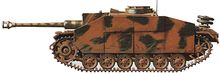
| German StuG III |
|
|
|
| The Sturmgeschutz III was cheaper and quicker to manufacture than a tank and by 1943 the assault gun battalions were being employed as substitute armour, although the limited gun traverse was a serious disadvantage when on the offensive. |
|
| |
|
 |
|
|
Estonia |
|
Casualties (1939
- 1945):
Soldiers (Neutral) - 200 Killed
Soldiers (Axis) - 5,000 Killed
Soldiers (Allied) - 2,000 Killed
Partisans - 1,000 Killed
Civilians - 2,800 Killed
Jews - 2,000 Killed
Soviet Occupation - 62,000 Killed |
|
|
| |
|
|
| |
|
|